
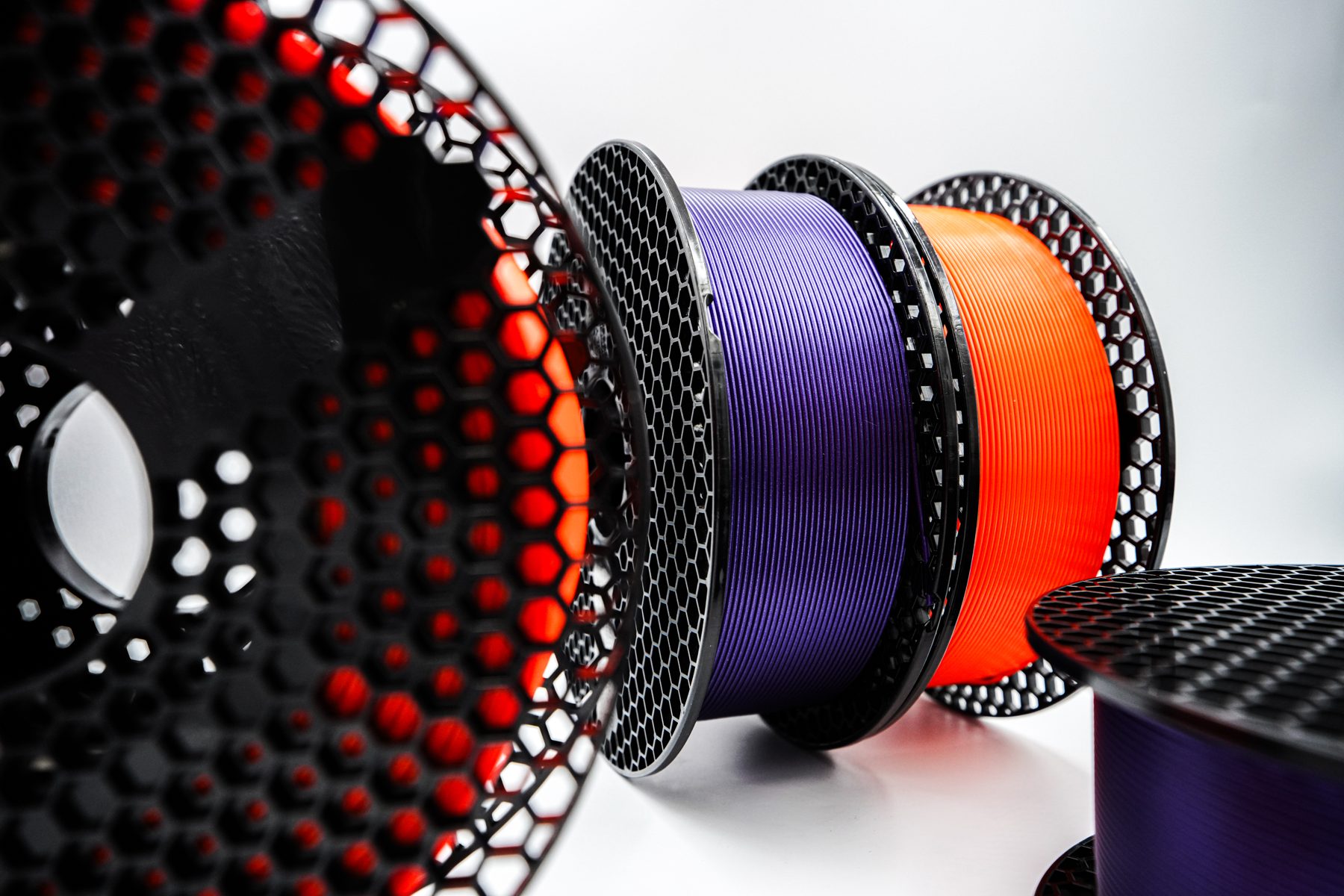
The best material for a 3D-printed prototype depends on what the prototype is for. A model that only has to look right on a boardroom table needs something very different from a bracket bolted to a machine, or a housing that will sit on a dashboard through a Dubai summer. This guide follows the way we choose at 3DWorks: start from the job, then pick the process and material that do it with the least fuss.
The short answer
If you only read one section, read this one:
- Looks-only concept models: PLA (FDM) for speed and low cost, or a standard SLA resin such as Grey when you want a smooth, detailed surface.
- Form-and-fit checks: PETG (FDM) for assemblies that will be handled and clipped together repeatedly; standard SLA resin when hole sizes and small features matter more than toughness.
- Functional parts that will be loaded or left in the heat: ASA or a polycarbonate blend on FDM; a tough or high-temperature engineering resin on SLA.
- Soft, rubber-like parts: TPU on FDM, or a flexible resin on SLA.
- Anything that lives outdoors or in a parked car in the UAE: avoid PLA. Use ASA, PC blend or a heat-resistant resin.
The rest of this post explains why, with the manufacturers’ own numbers linked so you can check them.
Start with the purpose, not the material
Most material mistakes come from choosing the material first. Answer three questions instead: what will the part be judged on (appearance, dimensions, strength, flexibility, heat), what will happen to it (sit on a desk, be assembled repeatedly, be loaded, be left in the sun), and how many iterations are coming. Early concepts that change weekly want the cheapest, fastest material; late prototypes that stand in for the final part justify a material that behaves like it. Those answers point to a process first, FDM or SLA, then to a material within it. Our FDM vs SLA comparison covers the two processes.
FDM materials for prototypes
FDM extrudes a thermoplastic filament layer by layer and is the workhorse for larger, cheaper and tougher prototypes. These are the filaments we reach for most often, with the manufacturers’ stated properties.
PLA: fast, cheap, and fine for concept models
Prusa’s material guide calls PLA one of the easiest materials to print, with low warping and no heated bed needed, and recommends it for concept models and prototypes. The catch is heat: the same guide says PLA gets soft and deforms at temperatures over 60 °C, has low UV resistance and is not suitable for technical or outdoor use.
Use it for: visual models, early form studies, scale models, anything that will be replaced next week.
Avoid it for: parts left in a car, near a window, or loaded in service.
PETG: the default for form-and-fit and light functional use
PETG is tougher than PLA and handles a little more heat. Prusament lists a temperature resistance of 68 °C, printing at 250 ± 10 °C with no enclosure, and describes it as a good choice for mechanical parts, holders and clamps, with layer adhesion good enough for waterproof prints. Its weaknesses are stringing, poor bridging and harder support removal, so very small or detailed features are better done in resin.
Use it for: enclosures, brackets, snap-together assemblies, jigs, anything handled repeatedly.
Avoid it for: tiny parts and prototypes that need a flawless surface straight off the printer.
ASA: the outdoor and heat choice
ASA is the material we recommend most often for UAE prototypes that will see sun. Prusament ASA shows no signs of deformation up to temperatures near 93 °C, is UV stable and will not yellow in long outdoor use, and can be smoothed with acetone for a car-paint-like finish. It prints at 260 ± 5 °C with a 110 ± 5 °C bed, an enclosure is recommended and large models are prone to warping, so it is a job for a well-set-up machine.
Use it for: outdoor fixtures, automotive and marine prototypes, housings that get hot, parts that will be painted.
Avoid it for: very large single-piece prints, unless split and joined.
Polycarbonate blend: the strongest everyday FDM option
When a prototype needs to be stiff, strong and stay that way in heat, a polycarbonate blend is the step up. Prusament PC Blend lists temperature resistance up to 113 °C, is intended for parts under mechanical stress, heat-stressed parts and functional engineering parts, and prints at 275 ± 10 °C with a 110 ± 10 °C bed. The manufacturer rates its printing difficulty as high and notes it tends to warp on large models, so use it where the extra strength is actually tested.
Use it for: load-bearing brackets, fixtures that run on real machines, under-bonnet style heat tests.
Avoid it for: early concepts where the expense buys nothing.
TPU: flexible and rubber-like
For gaskets, grips, bumpers and soft-touch parts, TPU is the FDM answer. Prusa’s flexible-materials guide puts typical TPU at 60A to 90A on the Shore hardness scale, and describes it as wear-resistant, dimensionally stable and resistant to many solvents. It is slow to print and poor at bridging and overhangs, so flexible parts are best designed as simple, self-supporting shapes.
Use it for: seals, feet, straps, protective covers, living hinges that have to survive real use.
Avoid it for: anything with fine detail or large overhangs.
Nylon and carbon-fibre composites sit above these for wear and stiffness but need drying, hardened nozzles and more setup; we discuss those case by case. Our materials guide covers nylon alongside PLA, ABS and PETG.
SLA resins for prototypes
SLA cures liquid resin with light and gives smoother surfaces and finer detail than FDM, which makes it the natural choice for presentation models, small mechanisms and anything a client will hold up to the light. Standard resins are more brittle than FDM thermoplastics unless you move to an engineering resin. The figures below are from Formlabs’ published material data.
Standard Grey, White, Black and Clear resins
These are the general-purpose resins for concept and form-and-fit models. Formlabs lists Grey Resin V5 at 62 MPa tensile strength with 13% elongation at break, and Clear Resin V5 at 60 MPa, polishable to transparency. They capture crisp detail and take paint well, but at that elongation they snap rather than bend, so they are for looking and fitting, not loading.
Use it for: presentation models, enclosures and housings that need a smooth finish, small detailed parts, master patterns.
Avoid it for: snap fits, parts that get dropped, parts that get hot.
Tough and durable resins
Where a resin prototype must be handled and assembled like the real thing, a tough resin gives you elongation. Formlabs lists Tough 2000 Resin V2 at 40.4 MPa tensile strength, 79% elongation and a 70 °C heat deflection temperature for heavy-duty prototypes, and Tough 1500 Resin V2 at 155% elongation for compliant mechanisms and snap fits.
Use it for: snap-fit housings, clips, functional assemblies that need SLA’s surface and detail.
Avoid it for: very stiff structural parts, which need a rigid resin instead.
Rigid, high-temperature and flexible resins
Three specialist resins cover the edge cases: Rigid 10K Resin (88 MPa tensile strength, 9,900 MPa flexural modulus) for stiff tooling and moulds; High Temp Resin (heat deflection temperature 238 °C at 0.45 MPa) for heat-exposed parts; and Flexible 80A Resin V2 (230% elongation) for grips and padding. Each is a committed choice: stiff resins are brittle, high-temperature resins are not tough, and flexible resins are not strong.
Materials by prototype type: a quick reference
| Prototype purpose | FDM pick | SLA pick | Why |
|---|---|---|---|
| Concept or visual model | PLA | Grey / White / Black resin | Cheapest, fastest; resin gives the smoother surface |
| Form-and-fit check | PETG | Grey resin or Tough 1500 | PETG survives repeated assembly; resin holds small features better |
| Presentation or client sample | ASA (sanded and painted) | Grey or Clear resin | Both take paint well; Clear can be polished to transparency |
| Functional, loaded part | PETG, PC blend | Tough 2000 / Rigid 10K | Match stiffness and toughness to the test, not to a guess |
| Outdoor or hot environment | ASA, PC blend | High Temp resin | PLA and standard resins deform in heat |
| Flexible or rubber-like | TPU | Flexible 80A | Choose by Shore hardness and how much it must stretch |
| Transparent part | — | Clear resin | FDM cannot produce clear parts |
The UAE factor: heat, sun and dust
Material advice written for European workshops often ignores the environment a prototype will be tested in. In the UAE it matters more than almost anywhere else. Parked cars and sunlit surfaces get far hotter than the air, so a PLA prototype that is perfectly happy in an air-conditioned office can slump in an afternoon on a dashboard; if the part will ever travel in a vehicle or sit near glass, start from ASA, PC blend or a heat-resistant resin. UV exposure is relentless, and PLA is listed by its own manufacturer as degrading under it, so ASA is the sensible FDM default for anything mounted outside even briefly. Dust and sand are abrasive, so moving parts tested outdoors need harder materials and generous clearances. And coastal humidity affects hygroscopic filaments such as ASA, PC blend and TPU, which is why a professional service dries and stores filament properly before printing.
Frequently asked questions
What is the best all-round material for a 3D-printed prototype?
For FDM, PETG. It is tougher than PLA, handles more heat, and prints without an enclosure. For SLA, a standard grey resin for appearance and fit, moving to a tough resin once the part needs to be handled or assembled.
Is PLA good enough for prototypes in Dubai?
For indoor concept models that stay in air-conditioning, yes. For anything that will be left in a car, placed near a window or tested outdoors, no: PLA deforms above roughly 60 °C and degrades under UV, so use ASA, a PC blend or a heat-resistant resin.
How do I know which material my prototype needs?
Tell us what the part has to do, where it will be tested and how many iterations you expect. We will suggest the process and material and flag anything that would print better another way; our rapid prototyping service explains how that works, and our file-preparation checklist covers what to send.
Next steps
If you have a part ready, send it to our 3D printing service in Dubai with a note on what it is for and we will recommend a material. If the design is not finished, our 3D design and modelling team can prepare it with the chosen material’s limits in mind, which usually saves a round of reprints. Either way, get in touch.


