
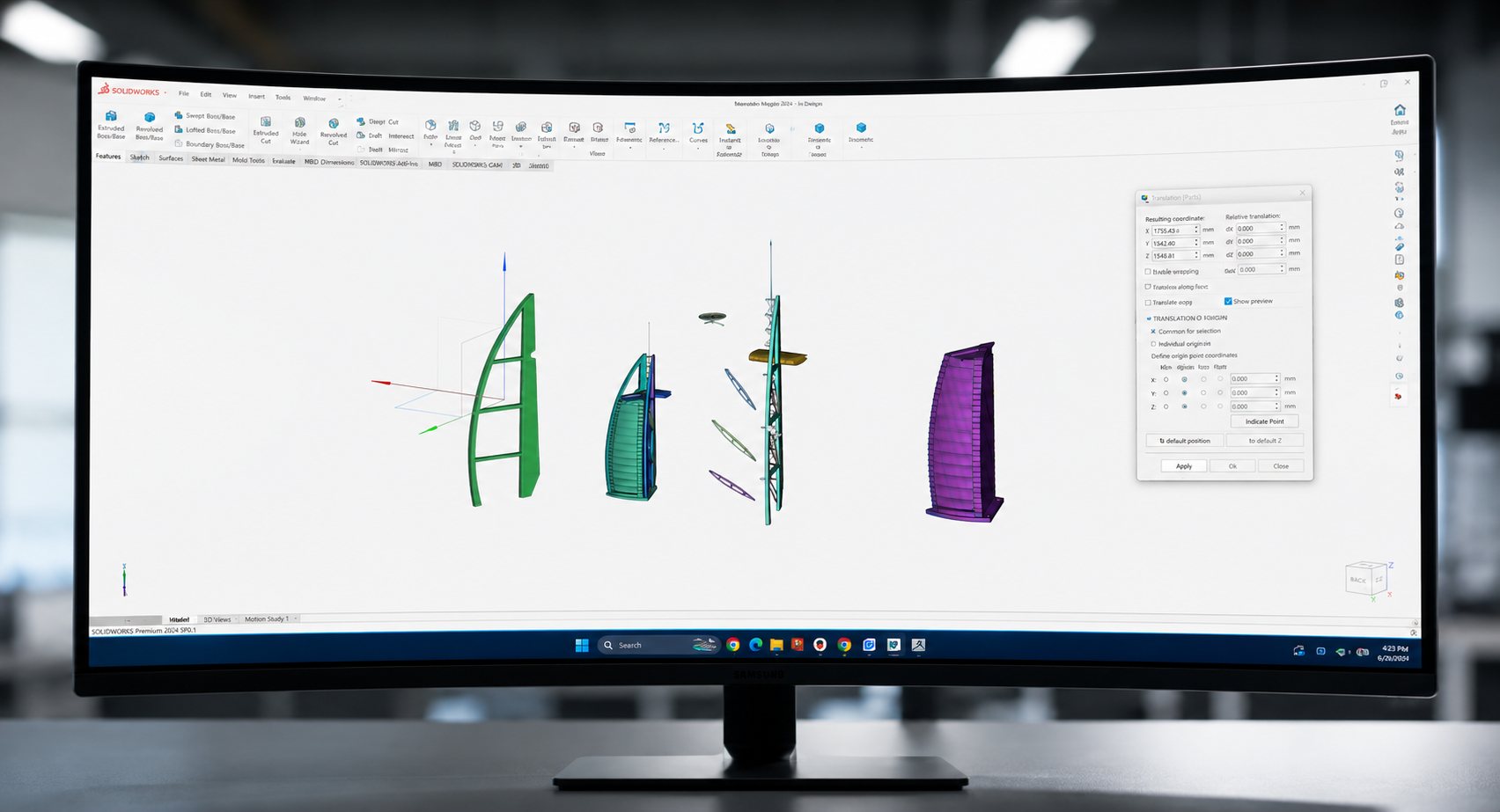
Reverse Engineering Services in UAE
When a part is obsolete, undocumented or out of production, reverse engineering recreates it. 3DWorks provides reverse engineering in the UAE — scanning existing parts, rebuilding accurate CAD, and producing replacements ready to use.
Our reverse engineering process
- 3D scan the existing part
- Rebuild precise, editable CAD
- Refine and improve the design where needed
- 3D printing in Dubai or machine the replacement
Ideal for
- Obsolete and hard-to-source parts
- Legacy industrial and oil & gas components
- Improving or customising existing parts
How reverse engineering actually works
Three stages, and they are not interchangeable. First the part is scanned, which produces a dense mesh describing the surfaces as they exist today. Then that mesh is cleaned and aligned. Then the geometry is rebuilt as a CAD model, feature by feature, using the scan as the reference rather than as the output.
The rebuild is the stage that takes the skill and most of the time. It is also the stage that decides whether you end up with something you can actually use.
A scan is not a CAD model
This catches people out more than anything else in the process. A scan is a shell of triangles describing one physical object at one moment, worn edges and casting marks included. You can print it. You cannot easily change it: there is no dimension to edit, no hole to resize, no wall thickness to adjust.
A rebuilt CAD model has all of that. It carries proper features, so a hole can be moved, a fillet softened, and a worn surface restored to what it was before it wore. If the part has to be modified, manufactured to a tolerance, or handed to someone else to work from, a mesh will not do and the rebuild is not optional.
What scans well, and what does not
Matte, opaque surfaces with defined edges scan cleanly. Shiny, mirrored and transparent surfaces scatter the light and need a temporary matting spray before they will read at all. Deep internal geometry is the real limit: a scanner sees only what the light reaches, so internal passages usually have to be measured directly, inferred from the part’s function, or recovered by sectioning a sacrificial sample.
Tell us up front if the part has internal detail that matters, because it changes the approach.
When reverse engineering is the right call
When the component is obsolete and the supplier is gone. When drawings never existed, or left with someone. When a part has worn and you need the original geometry back rather than a faithful copy of the wear. When legacy equipment needs a spare nobody sells any more. And when a physical sample is the only specification that exists.
Once the model exists the part can be printed or machined, and it can be made again in five years without the original in hand.
Frequently asked questions
Can you recreate a part with no drawings?
Yes — that’s exactly what reverse engineering is for. We scan the physical part and rebuild accurate CAD from it.
Can you improve the part while recreating it?
Yes — we can strengthen, adapt or customise the design as part of the process.
Get a free quote or chat with us on WhatsApp. Fast, no-obligation quotes — usually within 24 hours.


