
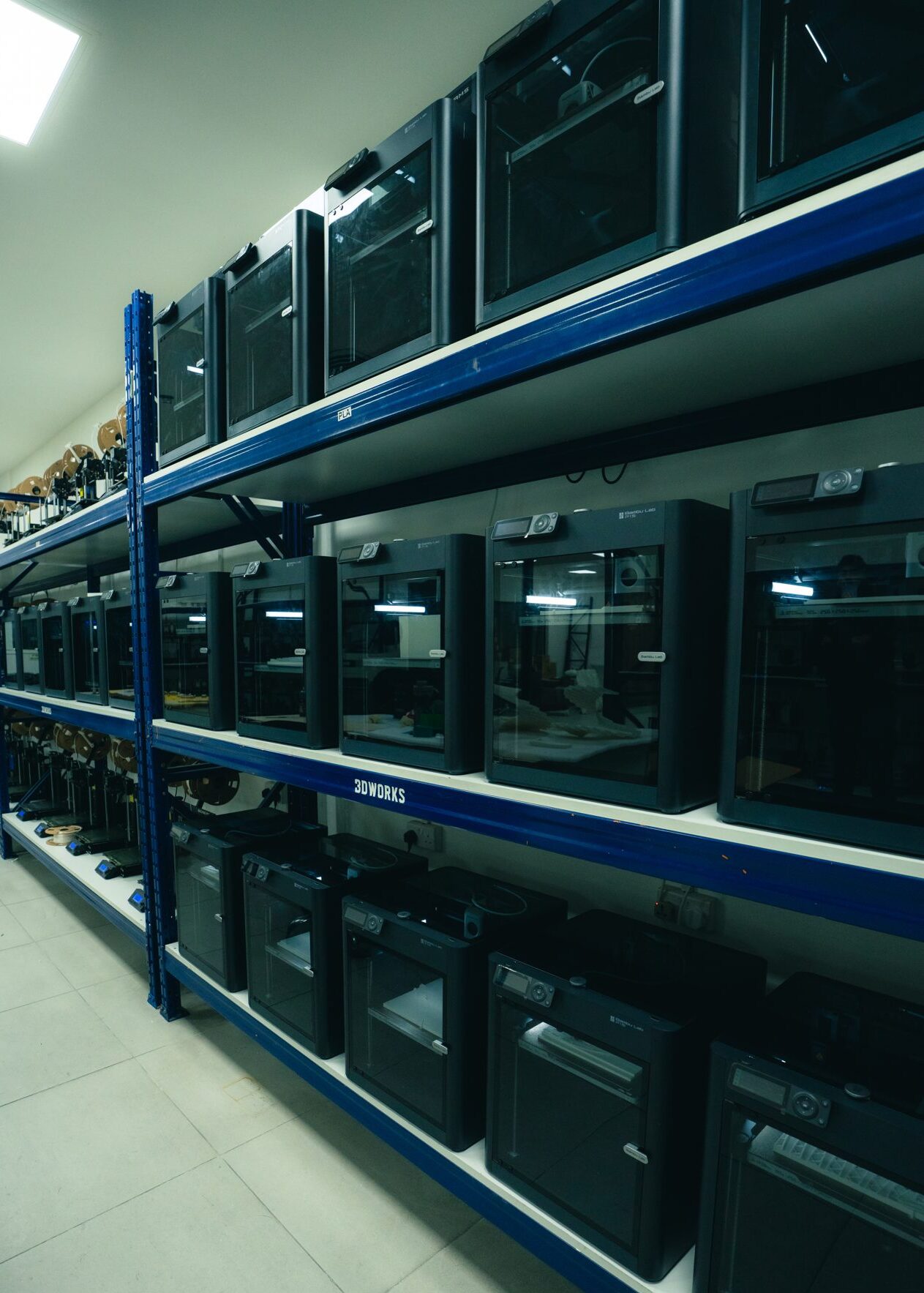
If you are weighing up FDM vs SLA 3D printing for an upcoming project, you are asking exactly the right question. The two technologies dominate desktop and industrial additive manufacturing across the UAE, yet they build parts in fundamentally different ways and suit very different jobs. Choose well and you get a part that is strong, accurate and cost-effective; choose poorly and you may pay for detail you did not need, or accept a rough finish that lets your prototype down.
This guide breaks down how each process works, how they compare on strength, accuracy, surface finish, materials and cost, and — most importantly — which one is right for your specific project. Whether you are producing a functional engineering bracket or a jewellery master with razor-sharp detail, by the end you will know exactly which route to take with our Dubai Production City team.
How FDM and SLA actually work
Fused Deposition Modelling (FDM) builds a part by melting a thermoplastic filament and depositing it layer by layer through a heated nozzle. It is the most widely used 3D printing method in the world because it is fast, affordable and works with tough engineering plastics. FDM is ideal for functional parts, jigs, housings and larger models. You can explore the full process on our FDM 3D printing in Dubai page.
Stereolithography (SLA) works in the opposite direction. A precise UV laser cures liquid photopolymer resin one thin layer at a time, pulling a solid part up out of a vat. Because the laser spot is far finer than any nozzle, SLA captures intricate geometry and produces a smooth, near-injection-moulded surface straight off the printer. See real examples on our SLA 3D printing in Dubai page.
FDM vs SLA at a glance
Before we dig into the detail, here is a side-by-side comparison of the two processes on the factors that matter most to UAE clients.
| Factor | FDM | SLA |
|---|---|---|
| Build method | Melted thermoplastic filament | UV-laser-cured liquid resin |
| Surface finish | Visible layer lines | Very smooth, fine detail |
| Typical accuracy | ±0.3–0.5 mm | ±0.05–0.1 mm |
| Strength | High — durable engineering plastics | Moderate — can be brittle |
| Best for | Functional parts, large models, jigs | Detailed prototypes, masters, miniatures |
| Relative cost | Lower | Higher |
| Max part size | Large | Small to medium |
Strength and durability
For anything that has to be handled, tested, clipped together or exposed to heat, FDM is usually the stronger choice. Materials such as ABS, PETG and nylon give real mechanical performance, which is why FDM dominates functional prototyping and end-use parts for the region’s manufacturing, oil and gas, and automotive sectors. SLA parts are dimensionally excellent but standard resins are more brittle and can degrade under prolonged UV exposure, though tough and engineering-grade resins have narrowed the gap for many applications. A useful rule of thumb: if the part will be stressed, dropped, screwed into or left in a hot car in the Dubai summer, lean towards FDM. If it will mainly be looked at, measured or used as a pattern for casting, SLA is the safer bet.
Accuracy and surface finish
This is where SLA pulls clearly ahead. If your part has fine text, thin walls, snap-fit features or organic curves, the SLA laser will reproduce them crisply with a smooth finish that often needs little or no post-processing. FDM parts show visible layer lines and benefit from sanding, priming or vapour smoothing when appearance matters. For visual models, presentation prototypes and anything where surface quality sells the idea, SLA is hard to beat.
Materials and applications
FDM offers a broad menu of durable thermoplastics — PLA for concept models, ABS and PETG for tougher functional parts, and nylon or carbon-fibre blends for demanding engineering work. SLA uses specialist resins tuned for detail, flexibility, casting or heat resistance. In practice, our Dubai clients reach for FDM for enclosures, brackets, mounting fixtures and large-format display pieces, and for SLA when they need jewellery masters, dental and medical models, miniatures, or highly detailed design prototypes. It is also worth thinking about part size. FDM print farms comfortably handle large single pieces and can split bigger assemblies, whereas SLA is best reserved for small and medium parts where its detail advantage justifies the cost. Matching the technology to both the function and the dimensions of your part is the quickest way to control your budget.
Cost and turnaround in the UAE
FDM is generally the more economical option, with simple functional prototypes often starting from around AED 150–300 depending on size, material and infill. SLA carries a premium because of resin costs and the additional washing and UV-curing steps, so detailed resin parts typically start a little higher. Turnaround for both is fast: many jobs leave our Dubai Production City workshop within 24 to 72 hours. If budget and speed are your priority and the part is functional, FDM wins; if the part’s value lies in its detail and finish, the SLA premium is money well spent.
So, which should you choose?
Choose FDM when you need strong, functional, larger or budget-conscious parts and can accept visible layer lines. Choose SLA when fine detail, smooth surfaces and dimensional precision matter more than raw toughness or size. Many projects actually use both — an FDM housing paired with SLA-printed detailed inserts, for example. If you are unsure, share your CAD file or a description with our team and we will recommend the process that gives you the best result for the lowest sensible cost.
Frequently asked questions
Is SLA stronger than FDM?
Generally no. Standard SLA resin parts are more brittle than FDM parts printed in ABS, PETG or nylon. Tough engineering resins improve durability, but for load-bearing functional parts FDM is usually the stronger, more reliable choice.
Which is cheaper, FDM or SLA?
FDM is typically cheaper because filament costs less than resin and the process needs less post-processing. SLA commands a premium for its superior detail and finish. We can quote both so you can compare directly for your part.
Can you do both FDM and SLA in Dubai?
Yes. Our Dubai Production City facility runs both FDM print farms and SLA resin printers in-house, so we can match each part to the ideal process — or combine both within a single assembly.
How fast can I get my parts?
Most FDM and SLA jobs are completed within 24 to 72 hours depending on size, quantity and finishing requirements. Rush turnaround is available for urgent projects across the UAE.
Still not sure whether FDM or SLA is right for your project? Send us your design and our Dubai Production City team will advise on the best process, material and finish for your budget and timeline. Request a free quote today and get your parts moving within days.


