
If you are searching for rapid prototyping in Dubai, there is usually a deadline behind the search. A client presentation on Sunday, a tender submission at the end of the week, a design review where a rendered image simply will not settle the argument. The question is rarely whether a prototype can be made — it is whether it can be in your hands before the meeting.
The short answer is yes: for most parts, a 72-hour turnaround from CAD file to finished physical component is entirely realistic. This guide walks through exactly what happens in those three days, which process suits which kind of prototype, what it costs in AED, how to prepare your files so nothing stalls, and the situations where a fast turnaround genuinely is not possible.
What rapid prototyping actually means
Rapid prototyping is the process of producing a physical part directly from a digital 3D model, without the tooling, moulds or fixtures that traditional manufacturing requires. Because there is no tooling step, the lead time collapses from weeks to days and the cost of a design change drops to almost nothing — you edit the model and print again.
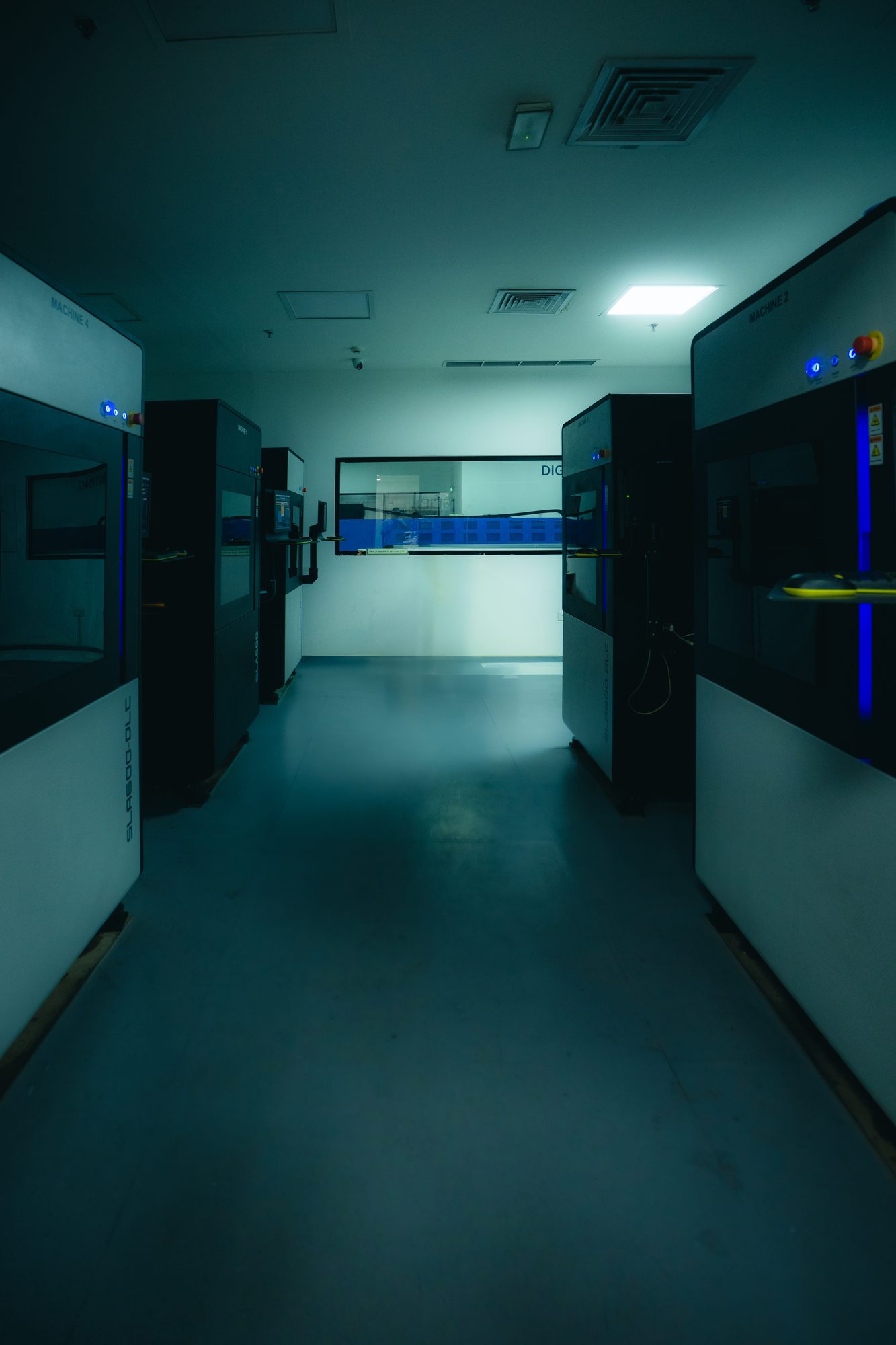
In practice the term covers several production methods. FDM and SLA 3D printing dominate for form, fit and visual prototypes; CNC machining takes over when the prototype must be made from the same metal or engineering plastic as the final production part. You can see the full range of processes we run in-house on our 3D printing and manufacturing technologies page.
The advantage is not only speed. A physical prototype exposes problems a screen never will: a wall that is too thin to survive handling, a snap fit that is a fraction too tight, a logo that disappears at actual size, an assembly that cannot be reached with a screwdriver. Catching those before tooling is where the real money is saved.
The 72-hour timeline: what happens each day
A three-day turnaround is not a marketing figure — it is a schedule, and every stage has to hold. Here is how a typical job moves through our Dubai Production City workshop.
- Day 1, morning — file review and quotation. Your STL or STEP file is checked for watertight geometry, wall thickness and feature size. We confirm material, finish and quantity, then issue a fixed quotation. Most quotations go out within a few working hours.
- Day 1, afternoon — build preparation. Once approved, the part is oriented, supported and nested with other jobs. Orientation is where an experienced operator earns their keep: it decides surface quality, strength direction and how much post-processing you will be paying for.
- Day 2 — production. The part builds. A palm-sized FDM component takes four to eight hours; a high-detail SLA part is often quicker; a machined aluminium prototype depends on the toolpath and set-ups required.
- Day 3 — post-processing and inspection. Supports are removed, resin parts are washed and UV-cured, machined parts are deburred. Any sanding, priming, painting or assembly happens here, followed by a dimensional check against your model.
- Day 3, end of day — collection or courier. Same-day delivery across Dubai and Sharjah is straightforward; Abu Dhabi and the northern emirates typically add a day.
The single biggest cause of a missed 72-hour window is not production — it is waiting for approval. A quotation that sits unanswered overnight moves the whole schedule by a day.
Choosing the right process for your prototype
Speed is a function of the process you pick, and the right process depends on what you actually need to prove. A concept model that has to look convincing on a boardroom table has very different requirements from a bracket that must survive a load test.
| Process | Best for | Typical lead time | Tolerance |
|---|---|---|---|
| FDM 3D printing | Form and fit models, jigs, large concept parts, housings | 1–3 days | ±0.3 mm |
| SLA resin printing | Fine detail, smooth surfaces, jewellery masters, small assemblies | 1–3 days | ±0.1 mm |
| CNC machining | Metal parts, engineering plastics, production-material testing | 3–7 days | ±0.05 mm |
| Vacuum casting | Short runs of 10–50 identical rubber-like or clear parts | 5–10 days | ±0.2 mm |
As a rule of thumb: if the prototype is being looked at, print it. If it is being tested under load or heat, machine it. If you need a handful of identical soft or transparent parts, cast them.
How to prepare your CAD file for a fast turnaround
Most delays trace back to the file, not the machine. A few minutes of preparation on your side removes a day of back-and-forth on ours.
- Send STEP where possible. STEP preserves true geometry and is far easier to adjust or machine from. STL is fine for printing, but export it at a fine resolution — a coarse mesh prints visibly faceted.
- Check wall thickness. Aim for at least 1.5 mm on FDM parts and 1 mm on SLA. Thinner walls print, but they arrive fragile.
- Model in millimetres. Unit mismatches are the most common reason a part arrives at the wrong size, and they are entirely avoidable.
- Make the model watertight. Open edges, inverted normals and self-intersecting surfaces all need repair before slicing.
- Say what matters. If one bore is critical, or one face must be cosmetic, tell us. Orientation and finishing can then be planned around it.
What rapid prototyping costs in Dubai
Pricing is driven by material volume, machine time and finishing rather than by part complexity, which is why an intricate lattice often costs less than a solid block of the same size. As a guide, small FDM prototypes typically start from around AED 150–400, detailed SLA parts from roughly AED 250–600 depending on resin and size, and machined aluminium prototypes from around AED 600 upwards.
Two levers move the number most. The first is finishing: a raw printed part is a fraction of the cost of one that is sanded, primed and painted to a showroom standard. The second is urgency — a same-day or overnight build has to displace other work on the machine, and that carries a premium. If your deadline allows a standard three-day slot, you will pay the standard rate.
When 72 hours is not realistic
Honesty here saves everyone a difficult phone call. A three-day turnaround does not apply to parts larger than a single build platform that need sectioning and bonding, to multi-part assemblies requiring paint matching and curing, to metal components needing anodising or plating from an external finisher, or to batch quantities in the hundreds. Vacuum casting also needs a master pattern and a silicone mould before the first part exists, which realistically means a week.
Equally, if your model still has open geometry or unresolved design questions, the fastest machine in the emirate cannot help. Tell us the deadline at the enquiry stage and we will tell you plainly whether it is achievable — and if it is not, what a sensible alternative looks like.
Why a local Dubai workshop makes the difference
Ordering prototypes from overseas can look cheaper on the quotation and rarely is once customs clearance, courier charges and a week in transit are added. More importantly, you lose the ability to walk in, hold the part and say the fillet needs to be larger.
Our Dubai Production City team runs FDM, SLA and CNC under one roof, which means a job can switch process without switching supplier and without restarting the clock. Clients across Dubai, Sharjah and Abu Dhabi regularly collect same day, review the part in person and have a revised version building the same afternoon. That feedback loop — not raw machine speed — is what genuinely shortens a development programme.
Frequently asked questions
How fast can I get a prototype in Dubai?
Most single parts are ready within 72 hours of quotation approval, and simple small components can often be collected the next working day. Larger assemblies, painted finishes and machined metal parts typically need three to seven days.
What file format should I send?
STEP is preferred because it holds true geometry and suits both printing and machining. STL works well for 3D printing if exported at a fine resolution. If you only have a 2D drawing or a physical sample, we can create the 3D model or 3D scan the part for you.
Is rapid prototyping expensive for a single part?
No — that is precisely its advantage. Because there is no tooling to pay for, a quantity of one costs roughly what one part in a batch of ten would. Small prototypes commonly land in the AED 150–600 range depending on process, size and finish.
Can a prototype be made from the final production material?
Often, yes. CNC machining can produce prototypes in the same aluminium, steel, acetal or nylon as the production part, which matters when you are testing strength, heat resistance or wear. For appearance models, a printed part finished to match is usually quicker and more economical.
If you have a CAD file and a deadline, send them both across and our Dubai Production City team will confirm the process, price and collection date — usually within a few working hours. Request a free quote and we will tell you honestly whether your part can be in your hands in 72 hours.


